Now enrolling K-10 full-time and homeschool classes!
Contact Us

The Classical Parent


CCEC – The Most Wonder-ful Time of the Year

December 12th, 2024

“The Most Wonder-ful Time of the Year” by Rebecca Tellinghuisen

When you think of “spiritual disciplines,” what comes to mind? Prayer? Reading the Bible? Fasting? Journaling? These are all good spiritual disciplines, or faith practices as they are also called. But what about wonder? I sometimes think — wonder! — if wonder is foundational for all spiritual practices. When the Spirit of the Lord moves in us and acts through us, any response of devotion on our part comes from, or should come from, a place of gratitude, reflection, and wonder. And isn’t Advent the very season of wonder?

We hope your household is spending time in the Gospel of John this Advent. And we hope that you are practicing wonder as you read and discuss together. Ask questions. Share stories. Draw pictures. And most of all, give thanks, for this wonderful gift: the Word made flesh who made his dwelling among us to bring light and life to all.

Wonder is certainly a spiritual act, but here’s the “discipline” part. Sometimes it takes work. Wonder can hit us out of the blue, without any effort on our part. It’s hard not to be left amazed while standing at the rim of the Grand Canyon. But what about an ordinary Monday when you feel overworked, underprepared, or just generally out of sorts? You may wonder how you are going to make it through the day, but you might struggle to stop, reflect, and wonder how God can use you – and even bless you — in life’s busier moments.


Speaking of busy, here we are halfway between Thanksgiving and Christmas. This can be a very full season. Lots to see. Lots to do. Lots to buy. Lots of this is good, of course. But does it leave us time to wonder? We invite you in the coming week to set aside time to pause and reflect on the beauty of this world, and specifically the beauty of the Incarnation, by reading or listening to “Recovering Wonder,” a short blog post from the Reformed Journal (and then taking a walk outside!) and by contemplating the words of the carol, “I Wonder as I Wander.”

© RRT, December 2024

“I Wonder as I Wander”
A Traditional Appalachian carol adapted by John Jacob Niles

I wonder as I wander, out under the sky,
how Jesus the Savior did come for to die
for poor ordinary people like you and like I;
I wonder as I wander, out under the sky.

When Mary birthed Jesus, ’twas in a cow’s stall
with wise men and farmers and shepherd and all.
but high from God’s heaven a star’s light did fall,
and the promise of ages it did then recall.

If Jesus had wanted for any wee thing,
a star in the sky, or a bird on the wing,
or all of God’s angels in heaven for to sing,
he surely could have it, ’cause he was the King.

I wonder as I wander, out under the sky,
how Jesus the Savior did come for to die
for poor ordinary people like you and like I;
I wonder as I wander, out under the sky.


CCEC – Enchanted by Fibonacci

November 14th, 2024

Do you recall a time when you delighted in learning something? Somewhere in the realm of elementary school, I was introduced to the Fibonacci sequence, and it fascinated me. I’ve always been drawn to patterns and puzzles, and here was a codified number pattern that warranted having its own moniker.  

On a recent episode of Basecamp Live, guest Bill Stutzman spoke of learning within the context of Proverbs 25:2, that we are doing the work of kings when we search out knowledge.

Proverbs 25:2 (NASB) 

It is the glory of God to conceal a matter, 

But the glory of kings is to search out a matter.

Searching out matters— a quest for discovery and for revelation is noble work that God has set before us! The pursuit of knowledge yields wisdom like treasures. The Fibonacci numbers were (and still are) a treasure to me. After learning how to read, this mathematical concept was a gold mine to delve (and children do yearn for the mines).

The Fibonacci sequence is often referenced when exploring the irrational number Phi, Φ, as the sequence mimics a close approximation. If you need a quick refresher, an irrational number is a number that cannot be expressed as a fraction, the most widely known being Pi, π. So, while using the Fibonacci sequence as a starting point 8/5 (1.6) all the way up to 6,765/4,181 (1.618033963166707), gets us closer to Φ. Phi is called the golden ratio and is also reflected in the golden spiral, which is found throughout history in the various visual arts from paintings to architecture. The patterns of Fibonacci and phi are also found in God’s creation, observed in the spirals of shells and horns, the spread of dahlia petals, and even the double helix of DNA.

Perhaps it was this early experience that allowed me to do something that is often missed in modern math education—become enchanted. I don’t know what came first—a delight in math or being comfortable with math—but I’m inclined to think that by first becoming enchanted with math, it became something I found comfortable (not necessarily easy but not insurmountable to work through) and even welcomely anticipated. If a student dreads a subject or is even apathetic toward it, something has gone amiss as we’ve disenchanted that area of knowledge. As Ken Myers points out in his introduction to Beauty for Truth’s Sake, “modern culture has disenchanted the world by disenchanting numbers. For us, numbers are about quantity and control, not quality and contemplation” (4).

Stratford Caldecott, the author of Beauty for Truth’s Sake, shares his delight and contemplations around phi. He writes about how subjects that we now typically refer to as STEM and often erroneously pit against the humanities, are vital to a complete liberal arts education. Caldecott writes, “If we look at the underlying principles or ideals that led the ancients to codify the seven Liberal Arts in the first place, we find there a vision in which the arts and sciences, faith and reason, are not separated, as they have been since the Reformation and the Enlightenment in our mainstream philosophies; rather they profoundly complement each other” (132).

We at Trinitas often speak of educating the whole child. If our and’s become or’s, “art or science,” “faith or reason,” we are in danger of teaching only a half or encouraging a student to choose only a half, we are in danger of stunting not only a student’s cognitive abilities, but their humanity as well. This is the beauty of a liberal arts education, that education is not merely a transmission of facts and figures, but the formation of whole persons. 

“The fragmentation of education into disciplines teaches us that the world is made of bits we can use and consume as we choose. This fragmentation is a denial of ultimate meaning… We do not need to be content with our fragmented worldview, our fractured mentality. It is not too late to seek the One who is ‘before all things’ and in whom ‘all things hold together’ (Col. 1:17),” writes Caldecott (17). 

If you have been around Trinitas for a while you’ve heard us speak of the trivium—grammar, logic, rhetoric—an ordering of how students learn. Caldecott spends most of his time focused on the other four facets of a liberal arts education, the quadrivium—arithmetic, music, astronomy, and geometry—and how they work with and expound the foundation laid by the trivium. “The ‘purpose’ of the quadrivium was to prepare us to contemplate God in an ordered fashion, to take delight in the source of all truth, beauty, and goodness, while the purpose of the trivium was to prepare us for the quadrivium. The ‘purpose’ of the Liberal Arts is therefore to purify the soul, to discipline the attention so that it becomes capable of devotion to God; that is, prayer” (90). 

Let us continue doing the work of kings, and let our curiosity lead us to pray without ceasing.

© SES 


CCE Corner – Where Everybody Knows Your Name

October 3rd, 2024

If you read Mrs. Tellinghuisen’s recent post “There’s No Place Like Home,” then you’ll understand the delight I felt as she opened our August in-service devotion with the suggestion that all stories are about seeking and/or finding home, and that if each story had to be condensed into one word, she would choose the word hospitality. When I heard her say that, I wanted to jump up and shout, “That’s my word too!” Well, one of my words. Without any prior conversation with Mrs. Tellinghuisen, I had planned for the afternoon’s professional development session to set the stage for a year-long focus on two things: scholé (more on that in an upcoming CCEC) and… you guessed it, hospitality. 

I began the session by playing part of the theme song from the popular 80’s television show Cheers. While referencing a sitcom might not seem particularly “classical,” I’d argue that in this case it’s not so far off. First, staff members of my generation quickly recognized the song from the popular culture of our teen years. Such recognition demonstrates the power of a classical pedagogical (and advertising) principle: content set to music often sticks with us, for better or for worse. Second, the song captures something central to human nature, and human nature is a central subject of classical education.  

Here’s how it begins:  

Making your way in the world today
Takes everything you’ve got
Taking a break from all your worries
Sure would help a lot
Wouldn’t you like to get away?… 

Sometimes you wanna go
Where everybody knows your name
And they’re always glad you came
You wanna be where you can see (ah-ah)
Our troubles are all the same (ah-ah)
You wanna be where everybody knows your name 

The song expresses quite well the deep human longing to be known, to feel “at home” and to be convinced others are glad to be with us. Because it satisfies this fundamental longing, Mrs. Tellinghuisen suggests that “hospitality is the point of all virtue.” I tend to agree. 

Of course, classical Christian education should help us to go deeper than the Cheers theme song (and it should give us better content than the show provided). The lyrics reference the sitcom’s setting when the singer croons, “Be glad there’s one place in the world/ Where everybody knows your name/ And they’re always glad you came…” That “one place in the world” that feels like home for the characters of Cheers is a bar in Boston. Where is that “one place” for us? At Trinitas, we hope there are several places—that in our school, our homes, and our churches we feel a deep sense of belonging. We hope these are all places where the forms of hospitality are learned from our Lord himself and demonstrated in acts of invitation, preparation, sharing, service, listening, and welcome.  

Our upcoming Grandparent/VIP Day provides an occasion for us to practice these forms of hospitality. Invitations have been sent. We’re preparing a program and classroom activities to share our school with grandparents and VIP’s. Early next week, with help from our faithful Parent Service Fellowship volunteers, students in grades K-8 will make all of the treats to serve our guests. Some will arrange flowers. Discussion questions are planned so students can listen to loved ones’ memories of what life was like for them when they were young. In these ways and more, we hope to welcome our guests so they will know we’re very glad they came. 

Such occasions for hospitality are mere imitations of the hospitality our Lord extends to us. Scripture teaches that he is preparing a place for us and that he makes these preparations out of love for us. Out of that same love, he became incarnate, lived and died and rose and will come again in the greatest acts of sharing and service ever known, for he rejoices in finding and restoring the lost. Scripture also teaches that the Word, through whom all things were made, does not talk all the time. After declaring it “good” and “very good,” God welcomed his creation with rest and with silence, and he built these into the rhythms of the world. The wise and the hospitable have learned from this that there is a time to speak and a time to be silent, a time to listen.* Perhaps most remarkable of all is that the creator, sustainer, and ruler of the universe invites us by name. He knew each of us in our mother’s womb, even choosing us before the foundation of the world. There are no greater acts of hospitality and no greater ways of being known and welcomed home than these.**  


*Neal Plantinga, “A Rhythm as Old as the World,” LaGrave Christian Reformed Church, July 28, 2024. 

**Some of the Scripture referenced: John 14:1-3, John 3:16, Romans 5:8, Luke 15, Genesis 1, Ecclesiastes 3:7, Proverbs 18:3, Isaiah 43, Isaiah 49, John 10, Psalm 139, Ephesians 1:4. 

© ALP


CCE Corner – There’s No Place Like Home

September 12th, 2024

Mrs. Tellinghuisen opened our August staff in-service with the following devotion. We were blessed by it and asked her if she would share it as our opening Classical Christian Education Corner piece for the school year.

Think of a good story you once heard. It can be from a book, film, play, or even sitting around a campfire. What was it about? Not just interesting characters, compelling plot, what did it say to you that really mattered? Can you condense that story—and more than the story, your experience of the story—into one word or a simple phrase? I would choose the word hospitality

It seems all stories are about seeking and/or finding home. Not just a home. But home, in the deepest, truest sense of the word. And though I’m not trained in philosophy or ethics, I suggest that hospitality is the point of all virtue. I’d call the source of all virtue love, the love of the divine maker who made us what we are and is making us much more than what we are. Love is the foundational what. But hospitality is the foundational why. Why love? Why grace? Because we all want to sit down, put feet up, just breathe, just be. Just be home.   

In the years I’ve taught Latin, I’ve found certain word pairings that students mix up. I see it the most with hospes and hostis. ‘Guest’ and ‘enemy’. There’s a big difference there, and while they are easy to decipher if you think of the derivatives (hospital, hospitality; hostile, hostility), they do look and sound a lot alike. And maybe it’s telling that they are so similar. The Bible says that we, even while we were yet sinners, separated from God, enemies even, even then we were invited to the banquet, guests of the master. Welcomed and loved.  

Now the tax collectors and sinners were all gathering around to hear Jesus. But the Pharisees and the teachers of the law muttered, “This man welcomes sinners and eats with them.” Then Jesus told them this parable: “Suppose one of you has a hundred sheep and loses one of them. Doesn’t he leave the ninety-nine in the open country and go after the lost sheep until he finds it? And when he finds it, he joyfully puts it on his shoulders and goes home.” (Luke 15:1-6a) 

He gives the lost sheep a home. The Good Shepherd is hospitality itself.  

This is the honest truth. I wrote my idea for this devotion on my phone at some ridiculous overnight hour when inspiration struck. When I typed hospes, the auto-correct function changed it to gospel. I loved that.   

At the June staff in-service, our first-day devotions were from the last few pages of Professor Jennifer Holberg’s book, Nourishing Narratives. She shares four things she most wants her Calvin University students to know: You are loved. You are enough. I want you to succeed. Your voice matters.  

The teacher-to-student messaging here is essential, of course, but so is the self direction. We want our students to be able to say these things to themselves. And we want them to say them, in words and actions, to one another. In our relationships, we’re all of us, at different times, on one side of the door or the other: invited as guest or inviting to a guest. And let us not forget, in our eternal home relationship, we’re all guests, and our host is all generosity.  

Imagine what this school (or any place) would look like if, at any time, a person felt invited and welcomed here. Valued here.  

Here at Trinitas we love books! And reading books about virtue is important and beneficial. But reading about virtue does not, in fact, make us virtuous. The gospels have plenty to say about hearers of the word as opposed to doers of the word, those who study the law and those who actually see its purpose of loving God and neighbor. 

You are loved. You are enough. I want you to succeed. Your voice matters.  

To these four, I would add a fifth that naturally follows: You belong here. 

Every story is essentially about seeking home. The best stories are where home is found. So, by all means, let’s teach those stories here at Trinitas and in our homes. But more importantly, let’s embody them by opening doors, pulling out the good chairs, and offering refreshment to any and all, but especially to the hungry, the hurting, and the overlooked. 

School is starting soon. Classrooms and hallways will be full of activity. And because we’re all human, on any given day, we surely have among us those who are hungry, those who are hurting, and those who are feeling overlooked. Our hospitality will tell them they belong here.  

Be devoted to one another in love. Honor one another above yourselves. Never be lacking in zeal, but keep your spiritual fervor, serving the Lord. Be joyful in hope, patient in affliction, faithful in prayer. Share with the Lord’s people who are in need. Practice hospitality. (Romans 12:10–13) 

© RRT, September 2024


CCE Corner – Consider the Dahlias

July 31st, 2024

We welcome Mrs. Tellinghuisen back to the CCE Corner as she shares some thoughts on beauty and testimony.

Consider the Dahlias – by Rebecca Tellinghuisen

“They look like Dr. Seuss flowers!”

So declared my 10-year-old upon seeing the rows and rows of dahlias at the Meijer Gardens Dahlia Show. And I never looked at them the same way again.

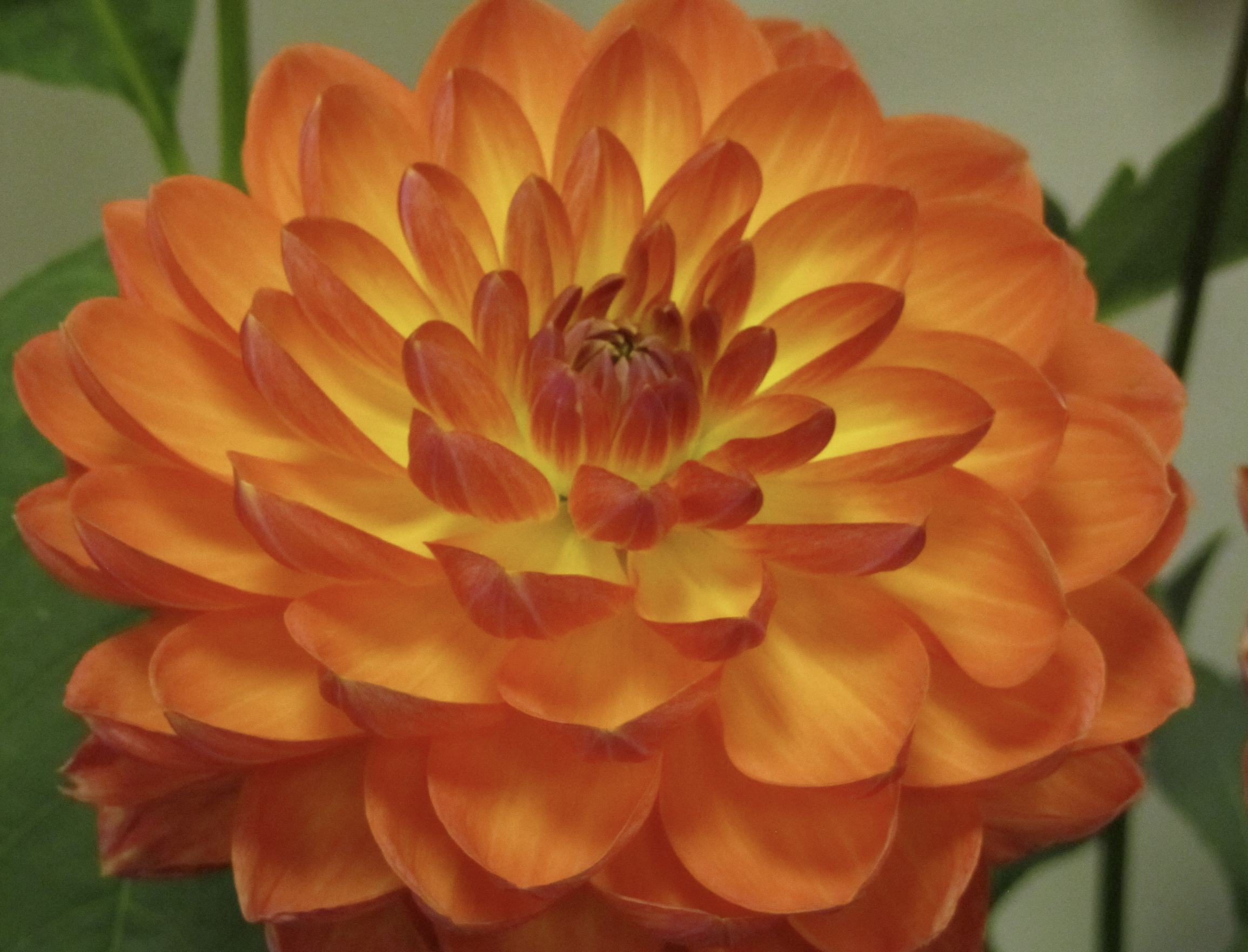
Dahlias captured my imagination the first time I attended the show. I was struck by the bold colors, the varied shapes and sizes, and the exquisite patterns. According to Better Homes and Gardens, there over 20,000 cultivars of dahlias.1 Having no expertise in gardening, or even basic house plant tending, I had to look up the word “cultivars.” It means (I think) all the varieties developed through the process of cultivation by selective breeding. It’s the answer to the question I always had at the Dahlia Show: How can these all be dahlias? One has a moon-faced coral pink blossom. Another looks like a purple spiky sea urchin. And next to those are a painter’s palette of pom-poms that look like lollipops. If these are all dahlias, then almost anything could be a dahlia? Apparently not. There are no blue dahlias because they lack a certain enzyme.2 I’m surprised I only just learned that fact, having attended the annual show at the Gardens for over a decade. How did I fail to notice there was no blue in that sea of color? I was probably too busy considering the dahlias.

They are mesmerizing. And yes, Seussical.

I’m not a photographer any more than I’m a gardener, but I bring my good camera (i.e., not just my phone) to the Dahlia Show and do my best. Photographs don’t do justice to some flowers, but dahlia patterns are so striking, the magnificence manages to find its way to you even in 2-D. Some varieties have the look of an advanced math problem. From what I’ve read, dahlias don’t appear to follow the Fibonacci sequence, though I still feel the urge to start counting, as if there might be a hidden code. There are deeper truths to discover, but they aren’t secret: beauty, elegance, symmetry, harmony. And glory.

The dahlias are indeed telling the glory of God.

“Testimony” was a weighty, almost scary, word to me when I was young. Testimony was what someone shared on a Sunday night service, usually a sinner-to-saint sort of story—wonderful, to be sure, but not something I could relate to as an ordinary “church kid.” Do I need that kind of story too?3 At summer camps during high school, each night ended with a campfire and a time of testimony. Campfire testimonies were generally about pretty big problems back at home and school. (We know young people are struggling with mental health concerns now, but they were 40 years ago too. We just didn’t have a clear enough lens to see it or the vocabulary to name it.) I sat there in the dark wondering, even fretting: Am I supposed to talk now? Is my testimony good enough? Is it “big” enough? I had bigger problems too, but I didn’t necessarily want to share those. At least not with a hundred other teens, some of whom I didn’t know, and most of whom I couldn’t see in the dark. We can share our stories anonymously (sometimes it’s the only way we dare let difficult words escape our lips), but I’m not sure we can testify anonymously.

Testimony is about witness and community. It does indeed take the form of “I once was lost, but now I’m found.” Praise God! I’m thankful I heard stories like that in church and around the campfire. But I wish 16-year-old me had realized that testimony was much bigger than those big stories because it includes our small stories too. “Small things make the big things grow — yeast that bubbles in the dough,” wrote Shirley Erena Murray.4 Small acts of love can make a big difference. But we shouldn’t forget about small words of testimony offered here and there, words that might find a home in another’s heart for years and years, opening a door to wonder, gratitude, or encouragement.

I once led a group of 3rd and 4th grade students in a Thoughtful Reader discussion on The Miraculous Journey of Edward Tulane by Kate DiCamillo. Edward is a vainglorious china rabbit who gets lost and finds home. At one point on his journey, Edward is broken, smashed against the edge of a countertop. The group talked about the importance of that moment, and one 4th grader, recognizing that Edward’s story is everyone’s story, said, “We have to be broken inside too.” I haven’t seen that student since his family left Grand Rapids a few years ago. He would probably be surprised that his testimony remains in my heart. It reminds me that every (good) story is the story of finding home by being made new.

My little one’s Seussical insight was a word of testimony to me as well, a call to remember that God is a god of wonder and whimsy. When I travel out to the lakeshore or farther away to the mountains or just a few blocks over to the grocery store, may the beauty of God’s creation lead me to both awe and merriment: the spiritual discipline of delight! And, more importantly, I hope I remember to testify to that delight. It’s never meant just for us.

The dahlias will be back at Meijer Gardens on August 24 and 25. I have no connection to the Gardens or their marketing department, but I’ll issue an invitation nevertheless—in singsong, Seuss-like rhyme, of course.

Consider the dahlias,
consider them, friend.
Of patterns and colors
and size without end.

They teach us a lesson
undoubtedly true:
If God cares for these,
then he must care for you.

So when you see flowers
in field, farm, or woods,
Remember the beauty
of a world made so good.

© RRT, July 2024

1https://www.bhg.com/gardening/flowers/facts-about-dahlias/
2https://www.americanscientist.org/article/the-chemistry-of-dahlia-flower-colors#:~:text=The%20colors%20of%20dahlia%20flowers,also%20influences%20dahlia%20flower%20color.
3Jennifer Holberg’s wonderful book, Nourishing Narratives: The Power of Story to
Shape Our Faith, speaks to our tendency to view stories as either “saint” or “sinner.”
Coincidentally, I ran into Jennifer at the Dahlia Show once.
4https://www.hopepublishing.com/find-hymns-hw/hw2909.aspx


CCE Corner – Lessons from St. John

June 6th, 2024

I begin this CCE Corner with a shameless plug for Bible Study Fellowship (BSF). * Participation in this group has blessed my family for more than two decades. This year, we’ve been studying the Gospel of John. When I re-read the final chapter this morning, I thought about Trinitas. Our school was founded in 2006 “to partner with Protestant, Catholic, and Orthodox families to guide students toward the wonder, knowledge, and love of God and his world, cultivating lives of faith, reason, and virtue.” What can we learn from John about how to do this?  

Before reading the rest of this post, I encourage you to read or listen to John’s prologue (John 1:1-18) and his final chapter (John 21). 

Read the rest of this entry »


CCE Corner — Fear Not: Failure and Formation, part I

March 7th, 2024

When I sat down to write this post, I struggled to find a title. Using the word “failure” produced something of a visceral reaction in me. Associating that word with Trinitas seemed like a bad marketing move. I decided to risk it. Our virtue focus this quarter is Perseverance. Our hall and classroom posters display a definition from Plato: “a bearing up under labor for the sake of what is honorable.” We all know perseverance involves labor; this post explores the bookends of that definition: the “bearing up” and the “for the sake of what is honorable” parts.

Taking the latter part first—what does Plato mean by “for the sake of what is honorable”? Hard work is always aimed at something. Sometimes we need to pause and ask, “What am I working so hard for?” Asking this question can produce all kinds of responses, from staying the course to relatively minor adjustments to existential transformations. It can be a motivating question—remembering a goal of running a marathon can get one out of bed on a cold, rainy Saturday morning. It can be a course-altering question—an examination of our family’s hectic weekly pace during middle school years led us to cut back on some activities (good as those activities all were). Notice that perseverance, with its “for the sake of what is honorable” framing, may actually lead someone to quit something. Perseverance that does not aim at something good or that comes at too heavy of a cost to other goods or better goods is not a virtue but rather the vice of obdurateness.

Read the rest of this entry »


CCE Corner – How and For What Are We Formed?

January 31st, 2024

Formation is at the heart of classical Christian education. This is no small task. As James K.A. Smith observes in You Are What You Love, we are daily being formed by participation, often unintentional, in ubiquitous secular liturgies. Many of those liturgies are making the work of educators and parents more difficult. We believe classical Christian classrooms and homes can and should be spaces for intentional and powerful counter liturgies and formation. We encourage you to listen to Restless Devices: Christian Formation in a Digital World, a Calvin University January Series talk by Felicia Wu Song. Join us as we practice liturgies designed to form us, not for “permanent connectivity” through devices, but rather for permanent communion through Christ.


CCE Corner — Light and Life to All He Brings: An Epiphany Meditation

January 11th, 2024

We welcome Mrs. Tellinghuisen back to the CCE Corner. This reflection for Epiphany was written last year for her church, Fifth Reformed, where she serves as a liturgical consultant and writer.

“The Twelve Days of Christmas” is not just a festive song about some extravagant (yet impractical) gift giving. They are days of the true Christmas season: the liturgical season of Christmastide, which brings us to Epiphany (January 6, by the calendar, with Epiphany Sunday celebrated on the 6th or the Sunday following it), and the beginning of Ordinary Time, the period before Lent.

Epiphany commemorates the visit of the Magi and the manifestation of the Light of the World to all those in the world. (The word comes from a Greek word meaning manifestation or appearance.) The kings are individual characters, uniquely situated in time and history, but they are representative of the Gentiles and the truth that salvation through Jesus is available to all. The Gift came to us all because God loves us all.

Read the rest of the meditation as featured in the Reformed Worship blog.

© RRT


CCE Corner — Trinitas Storytelling

December 7th, 2023

In C.S. Lewis’s The Horse and His Boy, a terrifying chase by lions ends with two horses and two children barely escaping across a narrow inlet of the sea. As the four gather their wits, Bree, a talking Narnian horse, lays out the plan: “And now that we’ve got the water between us and those dreadful animals, what about you two humans taking off our saddles and our all having a rest and hearing one another’s stories.” Bree asks one of the humans to speak first, and the narrator tells us: “Aravis immediately began, sitting quite still and using a rather different tone and style from her usual one. For in Calormen, story-telling (whether the stories are true or made up) is a thing you’re taught, just as English boys and girls are taught essay writing. The difference is that people want to hear the stories, whereas I never heard of anyone who wanted to read the essays.”*

It’s a humorous comparison of genres but one that might make those of us in classical education a little defensive. A philosopher by training, I feel the need to explain, “Well, joking aside, Lewis actually thought essays were important and interesting too…” We shouldn’t be quick to set aside Lewis’s primary point though: stories are powerful. They grab our attention, engage the imagination, arouse emotions, direct passions, shape beliefs. In short, they form us. While it is important to train students in logic and analytical reading and writing, we have to admit that stories are important too—probably more important. As Jennifer Holberg writes in Nourishing Narratives: The Power of Story to Shape our Faith, “[N]o matter what one’s childhood—even if one was not or is not really much of a reader—we are all profoundly story-shaped people. We live in a world that, for better or worse, most often seems to process through narrative, not facts.”** Trinitas is a school built on stories—on God’s story, and on the myriad stories that point us to Him.

Read the rest of this entry »